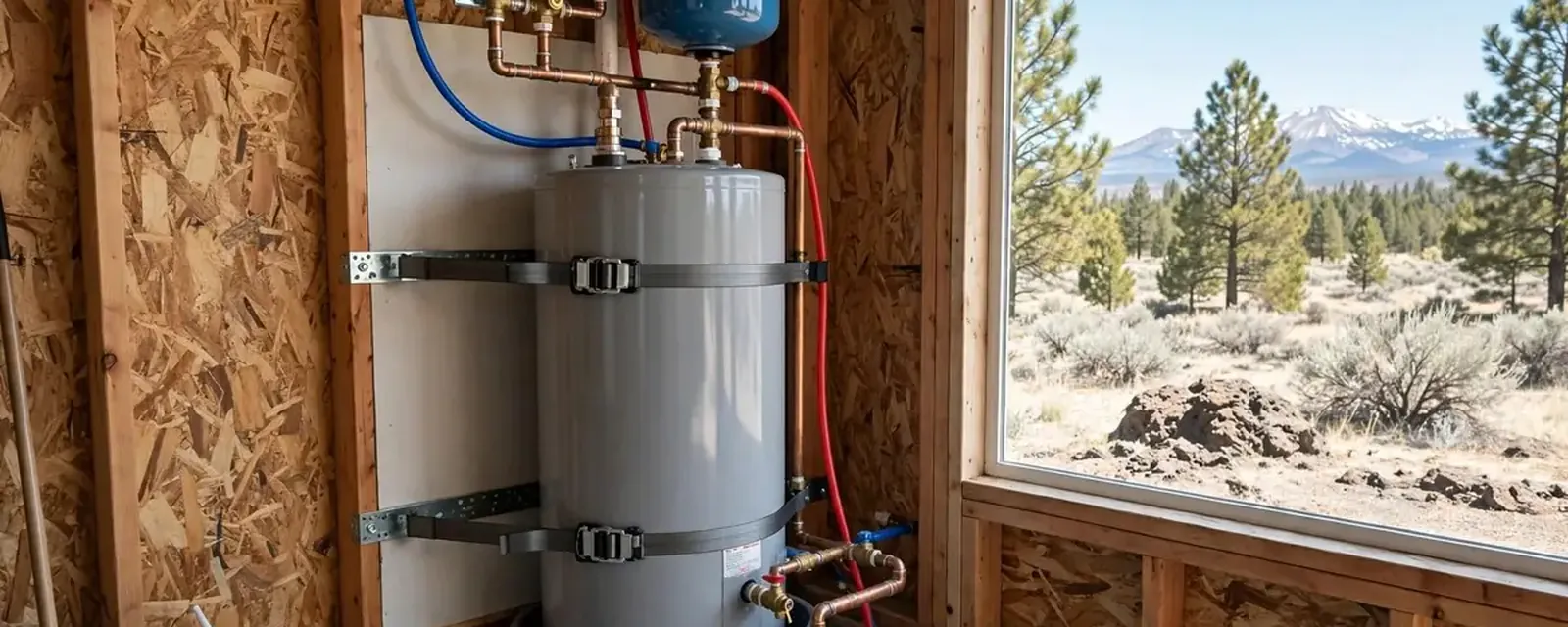
Start with how your household uses hot water
The first question is not brand but demand. How many people shower in the morning, whether a dishwasher and washer run at the same time, and whether a tub fills often all change the capacity you need.
A common mistake is buying by tank size alone. First-hour rating, which says how much hot water the heater delivers in its first hour, predicts real performance better than gallons. We read that number for you on every quote.
The installation sequence
Site visit.
We check space, venting, gas or electrical supply, and the route to a drain.
Quote.
You get a written scope and price before any parts are ordered.
Install.
We set the unit, connect water, gas or power, and fit relief and expansion devices.
Inspect and test.
We pressure test, check combustion on gas models and walk you through the controls.
Install options side by side
| Option | Space needed | Running cost note | Install detail |
|---|---|---|---|
| Gas tank. | Closet or basement with a flue. | Usually the cheapest fuel per hot gallon where gas is available. | Venting and gas shutoff are inspected. |
| Electric tank. | Closet, utility room or garage. | Simple but heats slowly when demand is high. | Needs the correct breaker and wire gauge. |
| Heat pump tank. | A room with open air and a drain. | Lowest electric bill of the tank types. | Condensate line and clearance are required. |
| Tankless gas. | Wall space and a vent path. | Efficient for low or steady use. | Larger gas line often needed, see tankless service. |
Venting, gas and drains: the installs that go wrong
Water heaters fail early when basic installation steps are skipped. A missing expansion tank on a closed system raises pressure each time the heater cycles. A relief valve piped to nowhere dumps scalding water on the floor. A poorly pitched flue pulls exhaust back into the room.
We check all three on every job and explain what we find. If your existing flue or gas line cannot support the new unit, we say so and price the correction instead of hiding it in the install.
Ready to schedule an install?
Call (301) 936-0389 and ask for the earliest planned slot. Same-day appointments are possible when available.
Permits and license checks
In Prince George's County, WSSC Water requires licensed plumbers or gasfitters for most plumbing and for all gas work, and applications are filed through its ePermitting portal. Some minor jobs may fall under a short form permit, and the plumber supplies the number you use to book the inspection.
Homeowners may do some plumbing under the Plumbing and Fuel Gas Code, but WSSC warns that gasfitting is off limits for DIY work. A water heater installation connects both water and gas, which is why we recommend leaving it to a licensed professional.
Installing in Greenbelt's different housing types
Space for a water heater depends on the individual home, so measure the utility area before choosing a tank. Greenbelt Homes, Inc. counts ten block homes with basements and twenty-five 1969 townhouses with basements among its housing. Those basements usually give easier access for larger tanks.
In garden apartment buildings, shared chases and shutoff limits can govern where a unit goes. In newer subdivisions around Greenbelt, builders sometimes leave a vent or a drain stub that makes a heat pump tank simpler to place. We look for those shortcuts on the first walk through.
If you are in a cooperative or a condominium, get written approval for the work first.
What the code expects from a new install
WSSC Water's plumbing and fuel gas code sets the standard for relief valve piping, venting, gas shutoffs and expansion control, and inspectors check them. NFPA 54, the National Fuel Gas Code, is the reference for gas piping and appliance connections.
A closed system, one with a pressure regulator or backflow device, usually needs an expansion tank so rising pressure does not damage the heater. We follow the manufacturer's installation manual and the code together.
Cost factors for installation
No two installs are priced alike, so we explain these items instead of quoting a flat figure by phone.
Want your real number? Installation is a planned upgrade, so homeowners insurance does not cover the cost, but a licensed installation helps support a later water damage claim. Call (301) 936-0389 and we will explain the price before work starts.
Frequently asked questions
Tank units cost less up front and suit larger households with steady demand. Tankless units take less space and give continuous hot water but need a larger gas line and regular descaling. We explain both on the call.
Yes, with the association's approval. Shutoff access, venting and building rules decide the type. Ask for the written rules before you order.
On a closed plumbing system, where a pressure regulator or backflow device blocks backflow into the main, an expansion tank absorbs the added pressure. We check your system and add one when it is needed.
Yes. Moving a heater changes supply, drain, venting and sometimes gas piping, so we scope each part and price it before starting.
Same-day appointments are possible when available, and stock decides the rest. If the unit has to be ordered, we give you the expected date when we quote.
We can plan the plumbing connections. Hardness in WSSC supplies varies by plant. Test your tap and compare it with the utility's report before you decide a softener is worth it.