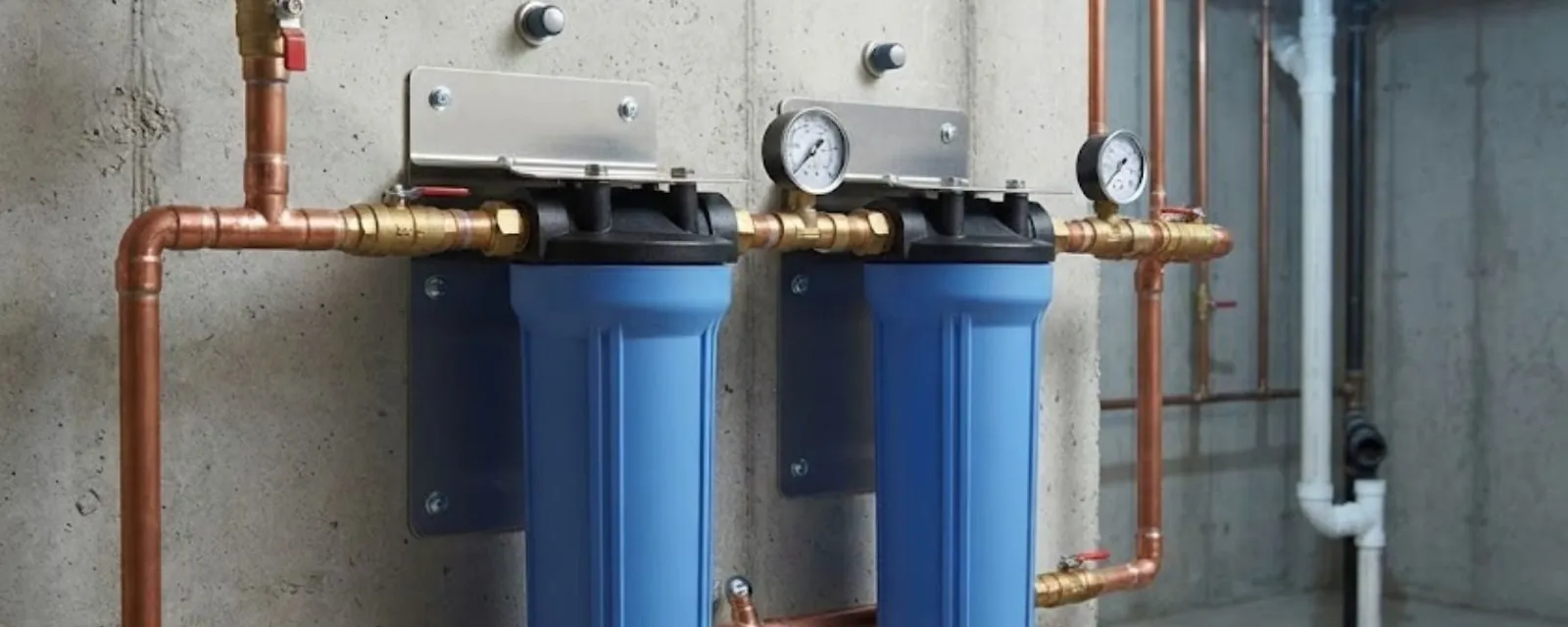
Stop the leak first
Close the inlet valve.
Shut the valve that feeds the filter. If there is no valve, close the main.
Relieve pressure.
Open a faucet downstream to drain the line.
Dry and watch.
Wipe everything dry so you can see where the next drip appears.
Photograph.
Take photos for the manufacturer or your insurer.
Where filter systems usually leak
| Leak location | Common cause | Fix |
|---|---|---|
| Top of the housing. | Cap not seated, damaged O-ring. | Reseat or replace the O-ring. |
| Around the cartridge. | Wrong cartridge, bypass seal worn. | Install the correct cartridge. |
| Fittings on the inlet or outlet. | Loose or cross-threaded connection. | Reseat with thread sealant, replace damaged fitting. |
| Cracked housing. | Overtightening, freeze damage or high pressure. | Replace the housing. |
| Pressure relief or drain valve. | Failed valve. | Replace the valve. |
The O-ring is the culprit more often than the housing
A rubber O-ring seals the housing where it screws on. If it is dry, nicked, twisted or the wrong size, the housing leaks at the seam. Remove the O-ring, wipe the groove, apply a thin coat of food-grade silicone grease and reseat it.
Tighten the housing by hand and then a quarter turn with the wrench supplied. Overtightening cracks the plastic. A new housing costs more than a new O-ring, so always try the seal first.
Filter system still dripping?
Call (301) 936-0389. We repair and reinstall filtration equipment.
Pressure, hammer and freezing
Many filter housings are rated for a maximum pressure. If your house pressure is higher, the housing will weep or crack over time. A pressure gauge on a hose bib shows your pressure. If it is above the rating, a regulator solves it for the whole house.
Water hammer, the bang when a valve closes quickly, stresses housings too. Freezing cracks a housing in an unheated space. Insulate the area or move the system.
What to bring to the call
- The make and model of the filter system and cartridge.
- A photo of where the water appears.
- Your water pressure reading if you have a gauge.
- The date of the last cartridge change.
- Whether the system is whole-house or under the sink.
Whole-house, under-sink and reverse osmosis systems leak differently
A whole-house system sits on the main line and handles full pressure, so a leak there can be large. An under-sink system has small fittings and tubing that can pop loose. A reverse osmosis system has a drain line and a storage tank that add more places to leak.
For an under-sink system, check the push-fit tubing connections first. A tube that has not been pushed fully into its fitting or that has been cut at an angle will leak. Trim it square and push it in firmly.
When the leak is from the plumbing, not the filter
Sometimes the water around a filter comes from a supply line, a shutoff valve or a pipe above it. Dry the area, wrap a dry paper towel around each connection and see which one gets wet first.
If the leak is at a soldered joint or a threaded pipe fitting upstream of the filter, that is plumbing work that needs a plumber. We repair the joint and test the system before you turn the filter back on.
Replacing a failed housing safely
Order the exact housing and cartridge model, and keep the old one for comparison. Turn off the water, relieve pressure, remove the housing and check the bracket and fittings. Install the new housing hand-tight plus a quarter turn, then open the valve slowly and check for leaks at each joint over an hour.
If you are not sure, have us do it. A bad installation can flood a basement.
Preventing the next leak
Install the system on a stable bracket, support the inlet and outlet pipes so they do not hang from the housing and add a drip pan or a leak sensor below it. Replace cartridges on schedule, using the manufacturer's O-ring and lubricant. Check the housing after each change for a day or two.
Know where the shutoff valves are and test them yearly. A valve that works makes any leak a small problem.
Warranty and support
Most manufacturers cover housings and valves for a limited time and expect the cartridge to be replaced on schedule. Keep the receipt, register the product and note the install date. If a part fails, photograph the failure and contact the maker before you throw it away.
If the system was installed by a plumber, call them first. A leak at an install joint is usually their responsibility to fix.
When the filter is the wrong tool
If you installed a system to fix a taste, odor or hardness problem and it keeps leaking, ask whether the system suits the water. Test the water, read the WSSC report and choose equipment that matches the issue. An oversized or mismatched system wastes money and creates more places to leak.
Ask a plumber or a water-testing lab to confirm what is in your water before you buy. A short test of hardness, chlorine and sediment is cheap and keeps you from paying for treatment you do not need. Keep the results with your records so a plumber can match equipment to them.
Standards for filter housings and fittings
Whole-house housings and cartridges that treat drinking water are certified to NSF/ANSI 42 and 53, and plumbing parts that touch drinking water carry NSF/ANSI 61 marks. Replacement parts should match the housing's own listing.
Cartridge change intervals in the manufacturer's guidelines are part of the product's certification. A housing left in service past that interval is more likely to crack or leak.
What WSSC says about your tap water
WSSC Water publishes a yearly tap water analysis report for its Patuxent and Potomac plants. The 2023 report lists yearly average hardness of 65 mg/L for Patuxent water and 140 mg/L for Potomac water. If you are choosing a filter, read the report first so the system targets a problem you actually have. For questions, WSSC customer service is 301-206-4001.
WSSC also says that most plumbing in the county must be done by a WSSC Water-licensed plumber. Cartridge changes and O-ring replacement are maintenance. Moving or adding a system connected to the supply is plumbing work. We repair leaking filter housings for customers in Lanham and Beltsville as well as Greenbelt.
Frequently asked questions
The O-ring was pinched or not seated, or the housing is cross-threaded. Remove it, inspect the O-ring and reseat.
Not on the housing threads unless the manufacturer says so. Use the O-ring for the seal. Tape belongs on tapered pipe threads at the fittings.
Attach a gauge to a hose bib. Many housings are rated around 100 psi or less, so check your model.
Sudden damage may be, but slow leaks usually are not. Document the damage.
Yes. We can install, relocate or replace systems. Confirm approval first if you live in a cooperative or condo.