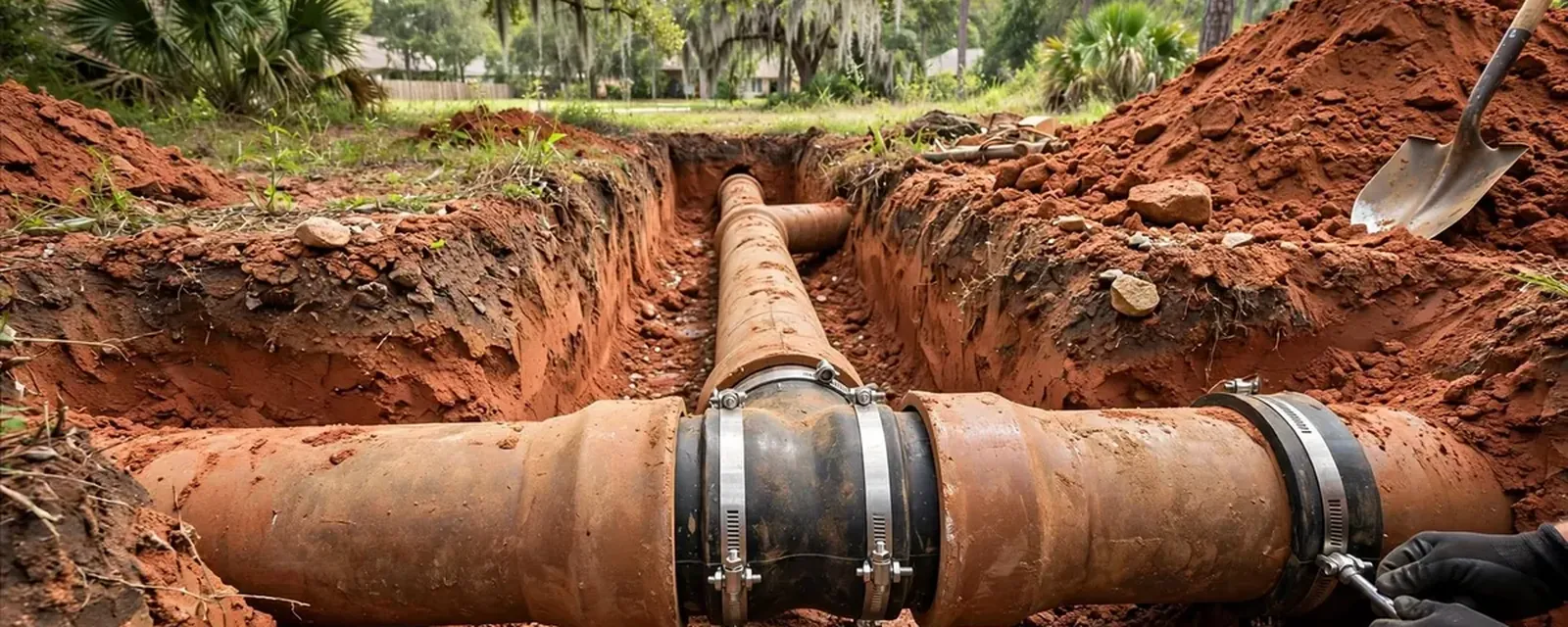
Signs of a damaged line under the house
Backups in the lowest drains.
A break or belly under the floor holds waste.
Sewage smell inside, no clog found.
A crack lets gas and liquid escape.
Wet or warm patches on the slab.
Leaking wastewater soaks the soil.
Foundation cracks or sinking floors.
Leaking pipes wash away soil.
Rodents or insects entering.
Broken pipes give them a path.
Repair options under a house
| Option | How it works | Best when |
|---|---|---|
| Crawl space spot repair. | Cut out the bad section and replace it from below. | The line is accessible in a crawl space. |
| Slab tunnel. | Dig a tunnel under the slab to reach the break. | A short section is broken and the slab is sound. |
| Break and replace the slab. | Cut the slab, replace pipe, repour. | Several sections are broken. |
| Pipe lining. | Insert a resin liner that cures inside the old pipe. | The pipe is cracked but not collapsed. |
| Pipe bursting. | Pull a new pipe through while breaking the old one. | Access pits are available at each end. |
Camera first, always
No one should quote a repair under a house without video of the pipe. A camera shows where the break is, how deep it is and whether the pipe is cracked, offset or collapsed. A locator marks the spot on the floor so the work can be planned.
We also look at the rest of the line. If one section has failed, the next section is often close behind, and it is cheaper to fix it while the floor is open.
Sewage backing up?
Call (301) 936-0389. We answer 24/7 and start with a camera.
Cleaning first, repairing second
A backed-up line has to be cleared before it can be inspected or lined. We clear it with a machine or jetter and then run the camera, so the video shows the pipe wall and not just water. See sewer line cleaning for what that step involves.
If you cannot use water because of the backup, tell us. We prioritize getting a line open so a household can use a toilet while the repair is planned.
The cost drivers, without guessing a number
The price of repairing a sewer line under a house depends on the depth, the length of the damaged section, the access, the method and the finish work. A short section in a crawl space is far less than a long run under a finished slab.
Ask for a written quote that names the method, the length, the restoration and the permit. If a quote lists only a lump sum, ask what is in it. A clear quote lets you compare contractors fairly.
Protecting your home during the work
Sewer repair is messy. We protect floors, set up dust barriers and keep work areas clear of children and pets. If the repair involves breaking a slab, we use equipment that limits dust, and we plan where the debris goes.
Arrange for temporary bathroom access if water will be off. If the home is rented, tell tenants and the owner in writing and coordinate the schedule.
After the repair: confirming the result
We run the camera again after the repair to confirm the pipe is continuous and sloped. The inspector verifies the work under the permit. You should receive the video, the permit and an invoice that lists the work done.
Keep those records. They help if you sell the house and they support an insurance claim if a future problem arises.
Questions to ask a contractor before work starts
Ask whether the contractor is a registered WSSC Master Plumber, who pulls the permit, what the method is and why. Ask for the camera video that shows the damage and what restoration is included.
Ask about warranty terms on the repair and the liner, and what happens if the line fails again in the same place. Ask for a written scope and compare at least three quotes.
Why clearing the line is not the same as fixing it
Cabling or jetting a broken pipe restores flow for a while, but the break stays. Soil and roots enter, and the blockage returns. If the camera shows a break, a belly or an offset joint, the pipe needs repair.
Put the clearing and the repair on separate lines in the quote so you can see what each costs. A good contractor shows you the footage before suggesting a repair.
Stopping a repeat failure
After a repair, keep roots, grease and wipes out of the line. Plant trees away from the lateral, put a cleanout where machines can reach it and have the line cameraed every few years if it is old. These habits protect the investment you just made. Keep every record from this repair, including the video, the permit and the invoice, in one folder.
Rules and standards for sewer work under a house
WSSC says only a registered WSSC Master Plumber may excavate or repair underground sewer pipes, and permits and inspections apply. Cured-in-place lining follows ASTM F1216, and defects on a camera report are often described using NASSCO's PACP codes.
Plastic sewer pipe is bedded and backfilled following ASTM D2321. Keep the permit number and inspection date with your house records.
Who must do the work, and who pays
WSSC Water says the lateral, the pipe from the property line to the building, is maintained by the property owner. It also says only a registered WSSC Master Plumber may excavate or repair underground sewer pipes, and that this requires a WSSC permit and inspection. WSSC advises asking for a copy of the permit.
WSSC recommends getting estimates from at least three plumbers and asking each for a registration number. If a blockage is in the WSSC-maintained section, WSSC clears it at no charge, and roots or a broken WSSC pipe may qualify for reimbursement through WSSC's Claims Office at 301-206-7095. WSSC's 24-hour sewer line is 301-206-4002.
Many Greenbelt Homes, Inc. houses are on slabs or crawl spaces, so the route to the line matters. Ask the cooperative about approvals before opening a floor or digging outside. Slab and crawl space sewer repairs also come up in Hyattsville and Lanham, where older clay and cast iron laterals are common.
Frequently asked questions
Sometimes. A liner or a tunnel from outside can avoid breaking the slab. The camera tells us which option the pipe allows.
WSSC Water says the property owner maintains the lateral from the property line to the building. The public main belongs to WSSC.
Yes. WSSC says underground sewer repair requires a WSSC permit and inspection, and only a registered WSSC Master Plumber may excavate or repair these pipes.
Often not for the line itself, but resulting damage may be covered. Ask your insurer about a sewer backup endorsement.
A spot repair can take a day or two. Slab work and restoration take longer. We give a schedule once the camera work is done.