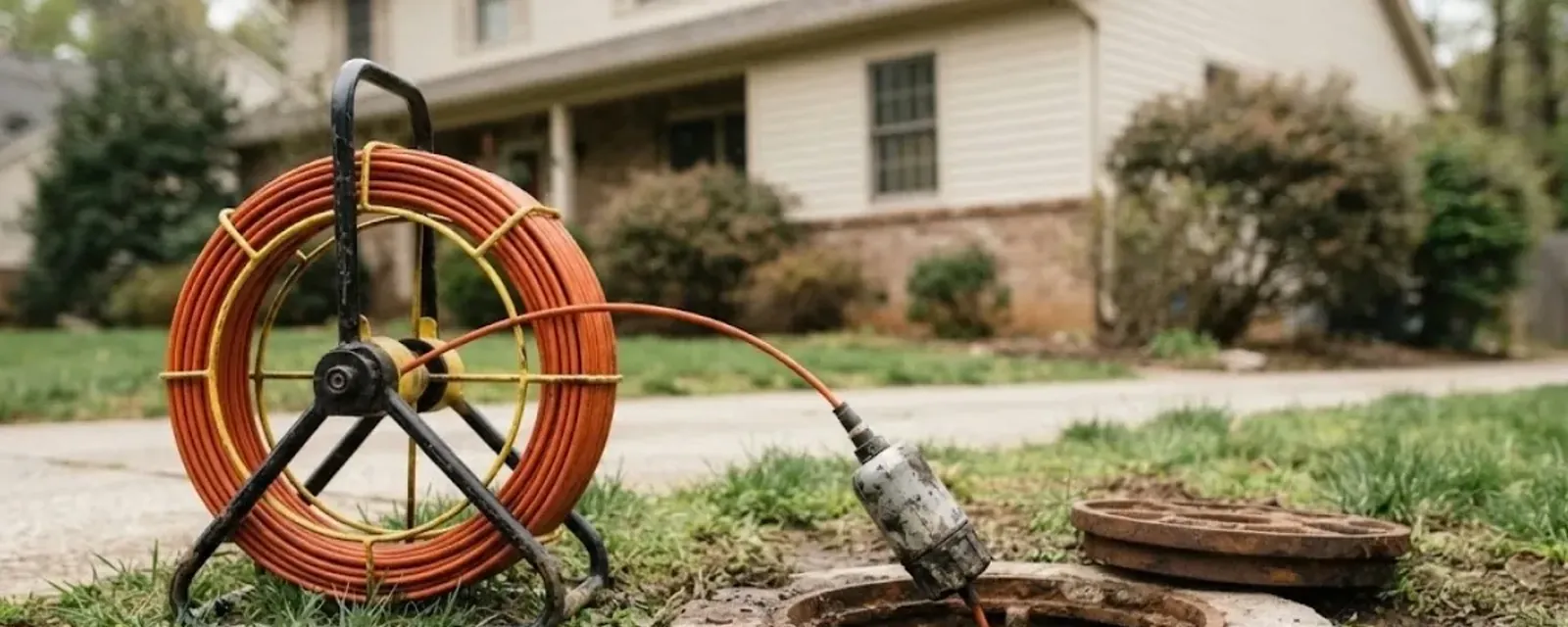
What the camera can show you
Root intrusion appears as pale hair or a dense mat at joints. A belly shows as standing water in an otherwise dry pipe. Cracks, offset joints and collapsed sections are visible as breaks in the pipe wall.
Scale and grease show as rough buildup. A clean, uniform pipe is a good sign too, and it is worth knowing before you spend money on a repair that is not needed.
How an inspection works
Access.
We open a cleanout or remove a toilet if no cleanout exists.
Run the camera.
The camera is pushed along the line while we record footage and depth.
Locate defects.
A transmitter lets us mark the surface above each defect and note its depth.
Report.
You receive the video, a summary of what was found and options if repair is needed.
What we look for and what it means
| Finding | What it means | Usual next step |
|---|---|---|
| Roots at joints. | Water is escaping at the joint. | Cut roots, then consider lining. |
| Belly (sag) | Pipe has settled and holds water. | Monitor, or replace the low section. |
| Cracked or broken pipe. | Wastewater leaking into soil. | Sewer line repair. |
| Offset joint. | Pieces have shifted apart. | Spot repair. |
| Heavy scale or grease. | Reduced flow. | Hydro jetting. |
| Clean and uniform. | Line is sound. | No action needed. |
Closing soon?
Call (301) 936-0389 and ask for the earliest inspection slot.
Pre-purchase inspection: why it pays
A general home inspector looks at fixtures and visible pipes. They cannot see the lateral. Older housing can have older lateral materials, though the age of a house alone does not tell you what is underground, and replacing a failed lateral can cost far more than the inspection.
If the camera finds a defect, you can negotiate the price, ask the seller to repair it or walk away. Request the video so your agent and attorney can see what we saw.
Condo and cooperative buyers should ask whose responsibility the lateral is. Greenbelt Homes, Inc. is a cooperative, so repair responsibility depends on its rules and your occupancy agreement.
After an inspection: knowing who pays
If the defect is in the public main, WSSC Water maintains it, and we stop and send you to them. If the defect is in your lateral, the repair is yours. WSSC publishes guidance on how responsibility splits, and we use the camera locator to show exactly which side of the line the defect is on.
Repairs under a WSSC permit are done by a WSSC Water-licensed plumber and inspected. We handle that for the work we do.
Understanding the report we give you
Every inspection ends with a written summary. It lists the pipe material we saw, its approximate diameter, the length of line we ran and the location and depth of each defect. We also note how clear the video was, since a dirty pipe can hide problems.
We rate findings in plain terms. Minor means monitor it. Moderate means plan a repair within a year or two. Severe means act soon. We never recommend repair for a clean pipe. If your pipe is fine, the report says so and you can keep the video for your records.
If you are buying, forward the report to your attorney and agent. If you are selling, a clean report is a selling point, because it answers a buyer's biggest unknown before they ask.
Other times a camera inspection makes sense
Beyond real estate, a camera is the right first step after two backups in a year, before a landscaping or driveway project that crosses the lateral, and when a tree near the line has grown large. It is also the best way to confirm that a repair was done well.
If the camera finds a blockage, we move to sewer line cleaning. If it finds structural damage, we outline the choices in sewer line repair.
The standard vocabulary for sewer defects
Many utilities and contractors code sewer defects using the NASSCO Pipeline Assessment Certification Program, known as PACP. It defines terms such as cracks, fractures, joint offsets, roots and deposits, and rates their severity.
You do not need a coded report for most homes, but it is worth asking for one when a sale, a dispute or an insurance claim is involved. Lining decisions refer to ASTM F1216, which describes how cured-in-place pipe is installed and tested.
What affects the inspection price
Inspections are straightforward to price. We quote before we start.
Want your real number? Inspections are not covered by insurance, but the video supports a claim if a covered event damaged the line. Call (301) 936-0389 and we will explain the price before work starts.
Frequently asked questions
Most inspections take under an hour once the camera is in the line. Cleaning a heavily blocked pipe first adds time.
Yes. You receive the recording and a plain-language summary of the findings.
It is a good idea. Original laterals in older housing can be clay or cast iron, and a repair is expensive. The camera shows the condition before you commit.
Yes, and it also shows what caused it. We can clear the line first if it is blocked. See sewer line cleaning.
No. The camera is flexible and moves through the pipe without harm. We take care around fragile or offset pipe.
Yes, including restaurant and apartment building laterals. See commercial plumbing.