Gas smell or carbon monoxide alarm: leave first
Gas and carbon monoxide are life-safety issues. Do not try to repair them.
- If you smell gas, leave the house at once and call your gas utility or 911 from outside.
- If a carbon monoxide alarm sounds, get everyone outside and call 911.
- Do not use light switches or phones inside if you smell gas.
- Call us only after the utility confirms it is safe.
Safe checks when the boiler has no heat
Thermostat.
Set it several degrees above room temperature and check the batteries.
Power.
Check the switch near the boiler and the breaker.
Pressure gauge.
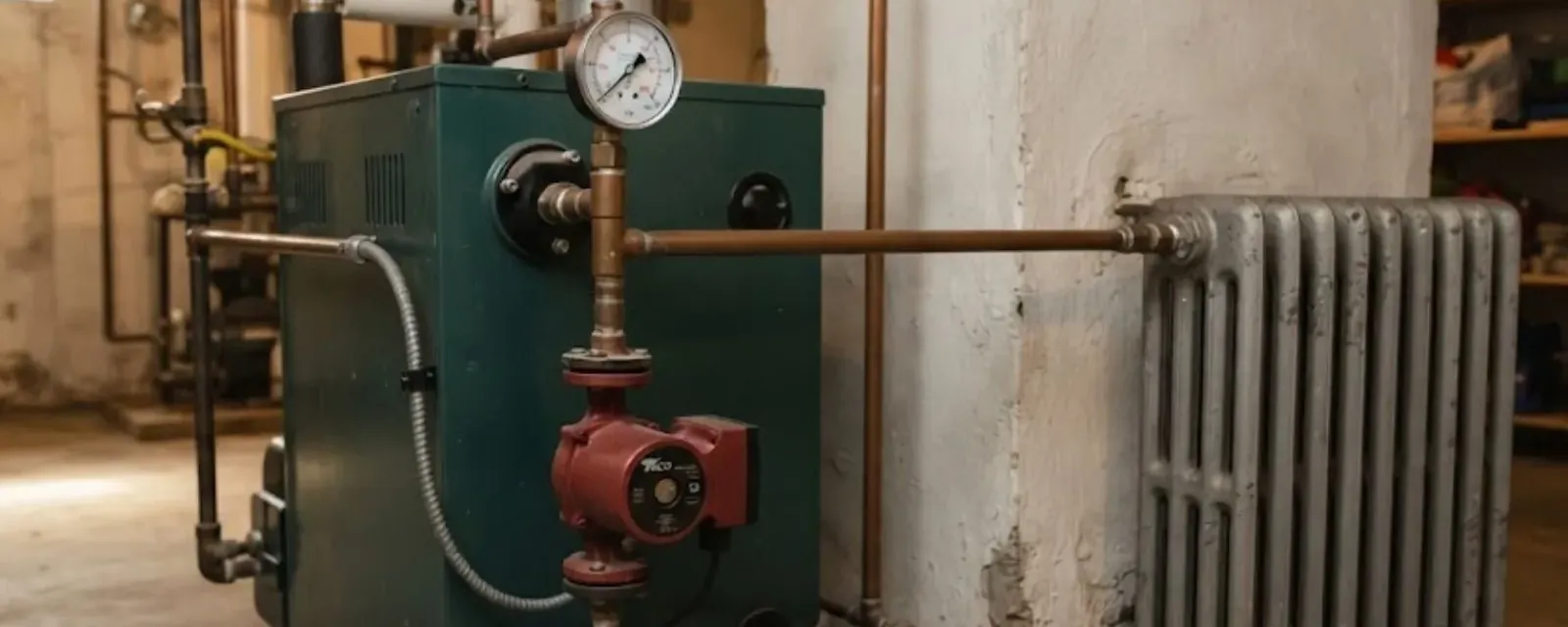
Most residential boilers run between 12 and 20 psi when hot. A gauge near zero means low water pressure.
Fuel supply.
Check that the gas valve is open or that the oil tank has fuel.
Reset once.
Press the reset button once. If it locks out again, stop and call.
Symptoms and likely causes
| Symptom | Likely cause | DIY? |
|---|---|---|
| No heat, no noise. | No power, tripped limit or igniter fault. | Check power only, then call. |
| Radiators cold at the top. | Air in the system. | Bleed radiators with a key. |
| Banging or kettling. | Scale or low water flow. | Call for a flush. |
| Pressure drops repeatedly. | Leak or failed expansion tank. | Call. |
| Water around the boiler. | Leaking valve, relief valve or tank. | Shut off water and call. |
Boiler down in the cold?
Call (301) 936-0389. We answer 24/7 for no-heat and leaking boilers.
What a boiler repair visit includes
We start with the safety checks: gas supply, venting, flame and carbon monoxide readings. Then we look at pressure, the circulator pump, zone valves and the expansion tank, because a failed part in any of them can shut down the heat.
If the boiler is old and parts are scarce, we explain whether repair or replacement makes more sense. Boilers can last decades, so repair is often right, but a cracked heat exchanger is not repairable.
Older homes and boilers in Greenbelt
Greenbelt Homes, Inc. describes many of its homes as block, brick and frame buildings from the late 1930s and 1940s, and older heating systems may still be in use there. Old piping, iron radiators and single-pipe systems need care because they hold a lot of water and scale easily.
If your system has not been serviced in years, a flush and inspection before winter is far cheaper than a midnight call.
Radiators, baseboards and zones: how the heat is delivered
A boiler is only the heat source. Hot water travels through pipes to cast iron radiators, finned-tube baseboards or in-floor loops. Each of them can fail separately, so a cold room does not always mean a bad boiler. A single radiator that stays cold usually has air or a stuck valve, while a whole zone that stays cold points to a zone valve or a circulator pump.
Zone valves are small motorized valves that open when a thermostat calls for heat. When one fails closed, its zone stays cold while the others work. A zone valve head can often be replaced without draining the system, which makes it a quick repair.
Why boilers lose pressure and what that tells us
A boiler holds a set pressure when cold, often around 12 psi, and rises as it heats. If the gauge keeps falling, water is going somewhere. A weeping relief valve, a leaking radiator valve, a pinhole in a buried return line or a failed expansion tank are the usual causes.
Adding water every few weeks hides the problem and adds oxygen and minerals that corrode the system. If you need to top up the boiler more than a couple of times a season, call us. We pressure test the system and find the leak.
Preparing the boiler before winter
Book a service visit in early autumn. A technician checks the burner, flue, controls, safety valves and water level, and flushes sediment if needed. Bleed the radiators, clear space around the boiler and keep stored items away from it.
Install a carbon monoxide alarm on each floor and test it when you change the clocks. If an older boiler is cycling often, leaking or noisy, ask for a replacement estimate before it fails in the coldest week.
Repair or replace: a fair way to decide
Age is the first factor. Many boilers last twenty years or more with care, so a boiler that is fifteen years old is not automatically finished. Consider how often it has failed, whether parts are available and how its efficiency compares with a modern unit.
Replacement makes sense when the heat exchanger is cracked, when repairs have become frequent or when the system cannot be made safe. Repair makes sense for a failed circulator, a zone valve or a control. Ask for both options in writing and compare them over the years you plan to stay.
Carbon monoxide and why annual checks matter
A boiler burns fuel and vents the exhaust outdoors. If the flue is blocked, cracked or poorly sealed, carbon monoxide can enter the house. The gas has no smell, which is why alarms matter. Install one on each level and near sleeping areas, and replace batteries yearly.
A service visit includes a flue inspection and a combustion test. If the technician finds soot, rust on the vent or a flame that burns yellow, the boiler needs attention before the next cold night.
Fuel gas standards that apply to boilers
Gas boilers fall under NFPA 54, the National Fuel Gas Code, and WSSC Water states that gas fitting must be done by a licensed plumber or gasfitter. Relief valves on boilers are tested to ASME standards, and they should never be capped or replaced with a plug.
Install guidelines from the manufacturer are part of what an inspector checks. If you smell gas, leave the building and call the gas utility from outside rather than trying to find the source.
Licensing and permits near Greenbelt
WSSC Water says gas fitting in Prince George's County must be done by a WSSC Water-licensed plumber or gasfitter and warns that gasfitting is not for DIY. WSSC names furnace and gas water heater replacements among the examples of work needing a licensed professional, and permits go through its ePermitting system.
WSSC also advises checking a plumber's license number by calling 301-206-8588. The City of Greenbelt says projects requiring a county building permit must also be permitted by the City. Ask us which applies to your work. Older boilers are common in Hyattsville and College Park too, so our crews bring parts for several systems.
Frequently asked questions
Air is trapped in them. Use a radiator key to open the bleed valve until water appears, then close it. Check the boiler pressure afterward.
Only if your manual allows it and the system has a fill valve. Overfilling can damage the system. If pressure keeps dropping, there is a leak.
Yearly. A check before winter catches failing parts.
Usually it is scale or air, but it can mean low water flow. Have it checked so it does not overheat.
Yes, with the cooperative's approval for any change to the heating system. Ask the cooperative about their rules.