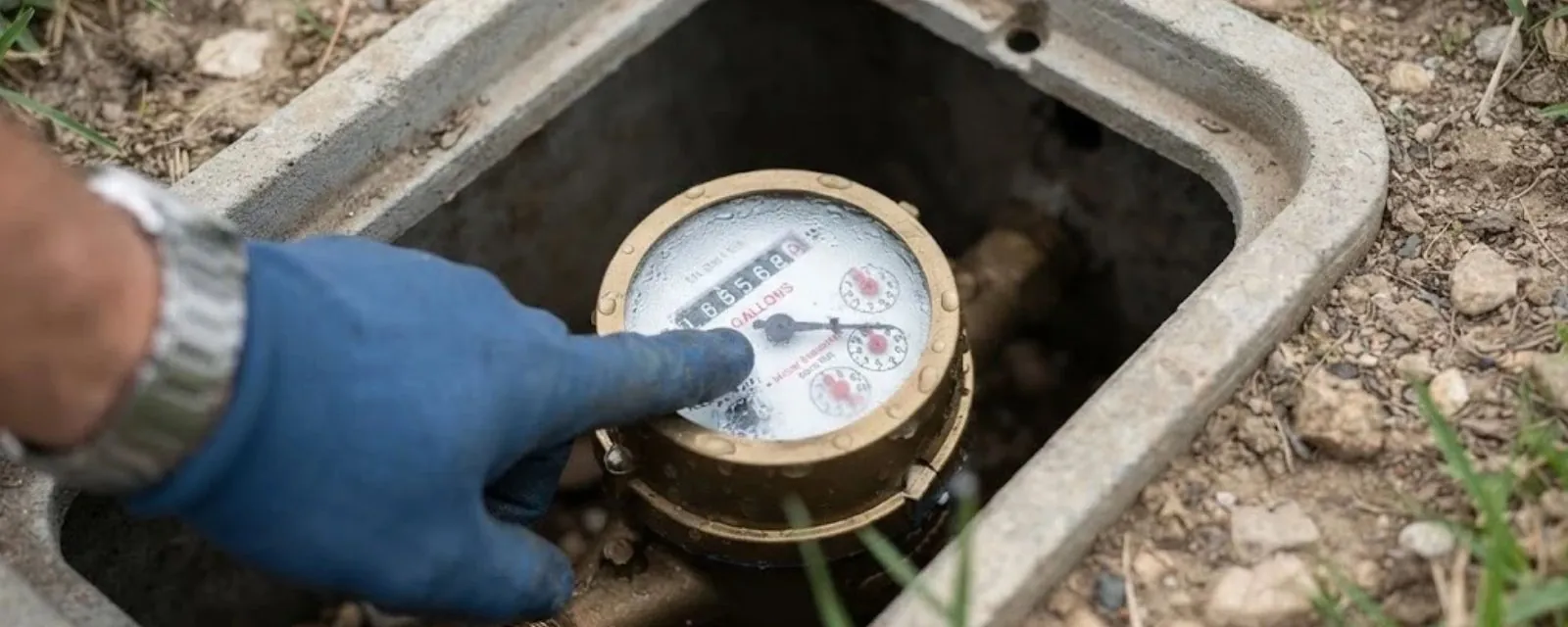
The meter test
Shut everything off.
Turn off all taps, the dishwasher, washer and ice maker. Check that no one is using water.
Find the meter.
It is usually in a box near the street, in the basement or in a utility space. Lift the lid carefully.
Look at the leak indicator.
A small dial or triangle spins when any water flows. If it turns with everything off, water is moving.
Record and wait.
Write down the reading, wait an hour without using water and read again.
Close the main.
Close the main valve at the house and watch the meter. If it still moves, the leak is on the line outside.
Reading the result
| What you see | What it means | Next step |
|---|---|---|
| Indicator still, reading unchanged. | No leak at this moment. | Check for a leak that only runs at certain times. |
| Indicator moves, stops when main closes. | Leak inside the house. | Check toilets, then call. |
| Indicator keeps moving with main closed. | Leak on the service line. | Call for leak detection. |
| Reading rises slowly. | Small leak, likely a toilet. | Dye test. |
Check the toilet first
A toilet is the most common source of a small hidden leak. WSSC Water's steps are to remove the tank lid, drop in one dye tablet, wait 15 minutes without flushing and see whether color appears in the bowl. If it does, water is leaking from the tank into the bowl. WSSC recommends checking for toilet leaks twice a year.
A worn flapper is the usual cause and is a cheap repair. If you find a leak, see toilet repair for what to do.
Meter says there's a leak?
Call (301) 936-0389 and tell us what the meter did.
Other places a hidden leak can start
Check outdoor hose bibs for drips, the irrigation system for a stuck valve, the water heater's relief line for a weeping valve and any basement or crawl space pipes for damp insulation. A humidifier or ice maker line can also leak into a cabinet where you rarely look.
If the meter moves but you find nothing inside, the leak may be underground. Wet patches in the lawn, a sunken spot or an unexplained green strip are common signs. We find those with listening equipment and tracer methods before anyone digs.
How much water can a small leak waste?
A faucet that drips once a second wastes thousands of gallons over a year. A running toilet can waste far more. Even a slow leak in a service line can run for weeks before you see a puddle. That is why the meter, and not the eye, is the best leak detector.
The earlier you find a leak, the less you pay and the less damage it does. A leak that soaks a basement wall or a slab can lead to mold and structural problems.
Using your bills as a clue
Compare the last six bills. A steady rise with no change in the household suggests a growing leak. A sudden jump suggests a break. A bill that is the same every month when you were away suggests a constant leak.
Keep your bills and the meter readings you take. If you need to ask WSSC about the bill or work with an insurer, the record helps.
What to do when you cannot find the leak
If the meter test says there is a leak and you cannot find it, stop searching and call. Pinpointing a leak in a slab, a wall or an underground line takes equipment such as acoustic listeners, thermal cameras and pressure testing.
We isolate each part of the plumbing system to find which branch is leaking, then locate it within a few feet. That saves you from tearing out more than you must.
Keep a simple leak log
Write down the date, the meter reading and what you did each time you test. Add notes about any repairs. After a fix, take the meter test again to confirm the leak is gone. A log shows how fast water is leaking and helps your plumber and your insurer.
If you have a smart water monitor or a shutoff valve, test it and know how to use it. A device that closes the main when it detects a leak can save a house, but it still needs a plumber to repair the source.
When the meter is hard to read
Some meters have dials that you read like a clock. Others have a digital display. In either case, the low-flow indicator is the quickest check. If the meter box is full of water or dirt, take care not to damage the lid or the reading device.
If you cannot find the meter or open the lid, do not force it. WSSC can help you locate and read it. Never work in a meter pit near traffic.
Leaks that only happen at certain times
Some leaks appear only when a system runs, such as an irrigation zone at dawn, a water softener regeneration at night or a humidifier on a timer. If the meter test is clean, repeat it at a different time, or watch the meter during the suspect cycle.
Write down when the pattern appears. That detail often leads straight to the cause.
WSSC's own guidance for leak checks
WSSC Water's guideline for customers is a dye tablet test of every toilet. Drop in a tablet, wait 15 minutes without flushing and check twice a year. Color in the bowl means the flapper leaks.
WSSC's CAP Leak Repair Program, run with Habitat for Humanity Metro Maryland, exists for eligible customers who cannot afford a repair. Call customer service at 301-206-4001 to ask about it.
WSSC's rules and help
WSSC Water's customer service number is 301-206-4001, and its water and sewer emergency line is 301-206-4002. WSSC explains that its responsibility for a water service line runs from the main to the property line, and the customer owns the portion from the property line into the home.
WSSC also runs a CAP Leak Repair Program in partnership with Habitat for Humanity Metro Maryland to repair on-property residential plumbing leaks for eligible customers. If cost is a barrier, ask WSSC about it. WSSC says homeowners can fix toilet and faucet leaks themselves or hire a registered licensed WSSC Water plumber. We run the same meter test for customers in Beltsville and Berwyn Heights when a bill jumps without a reason.
Frequently asked questions
Run the meter test. If the indicator moves with everything off, you have a leak. If it does not, look at usage changes such as guests, irrigation or a pool fill.
It is often in a box near the street or inside the building where the line enters. If you cannot find it, WSSC can help at 301-206-4001.
WSSC says the customer owns the service line from the property line into the home, and WSSC is responsible from the main to the property line.
Sudden damage may be covered, but slow leaks are often excluded. Read your policy.
Usually we narrow it down with listening equipment first and dig only where needed.