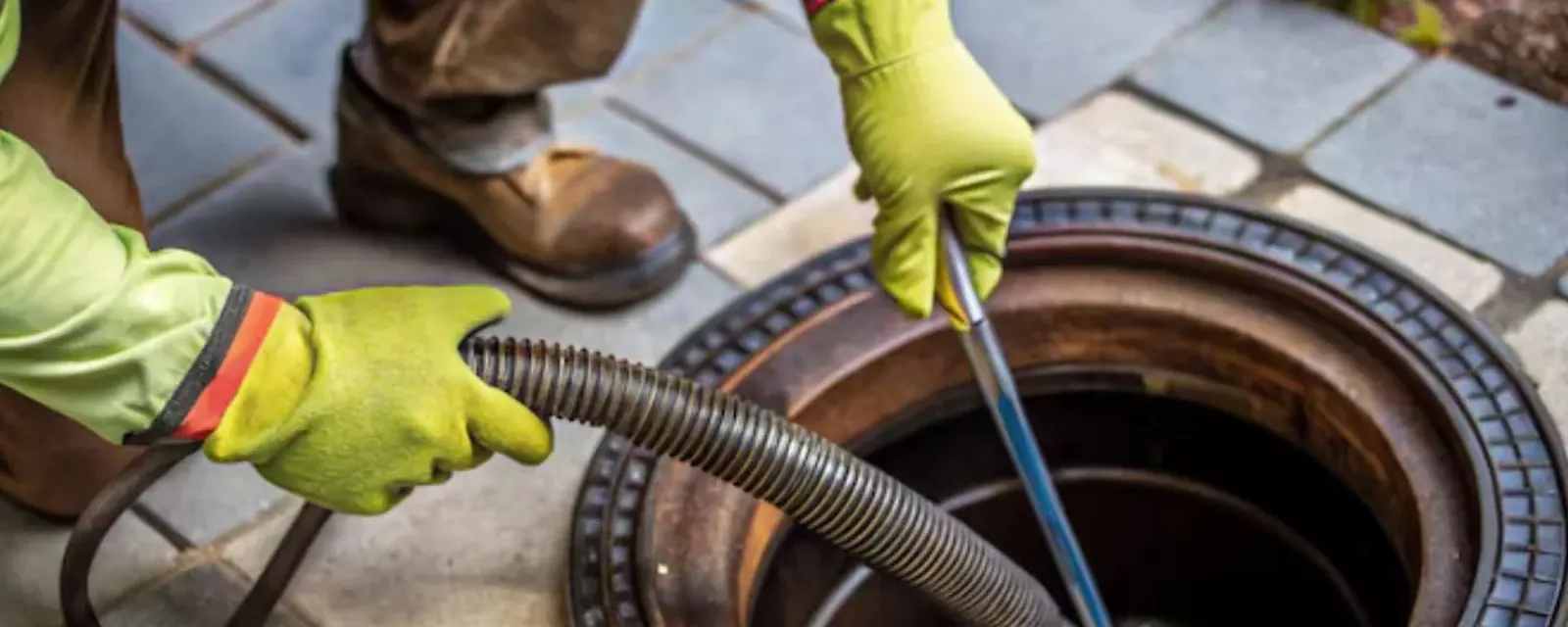
Why buried gutter drains clog
Gutter debris, shingle grit and silt wash into the downspout and settle in the lowest part of the pipe. Over a few seasons the pipe fills. Roots then find the joints, because the pipe always holds moisture.
Corrugated pipe collects more debris than smooth pipe, and a flat section holds standing water that never fully drains. If the outfall is buried or blocked by plantings, water has nowhere to go.
How to flush an underground gutter drain
Clean the gutters first.
Clear leaves and grit so you do not push more into the pipe.
Disconnect the downspout.
Remove the elbow so you can reach the pipe opening.
Flush with a hose.
Push a garden hose into the pipe and run water at full flow. Watch the outfall for dirty water and then clear water.
Check the outfall.
Clear leaves and soil from the pop-up emitter or the end of the pipe.
Test.
Pour a bucket of water into the gutter and check that it flows out within a minute.
Common outcomes and what to do
| What you find | Likely cause | Next step |
|---|---|---|
| Clear water at the outfall after flushing. | Light clog. | Maintain twice a year. |
| Little or no flow at the outfall. | Blocked or crushed pipe. | Camera inspection. |
| Roots in the flush water. | Roots in a joint. | Cutter head, then repair the joint. |
| Water backs up at the downspout. | Blocked between downspout and outfall. | Professional drain cleaning. |
| Standing water at the outfall. | Outfall too low or no slope. | Regrade or reroute. |
Gutter drain still blocked?
Call (301) 936-0389. We clear buried drains and can run a camera to find the break.
Do not connect it to the sanitary sewer
A gutter drain should carry roof water to a storm outlet or the yard, never to the sanitary sewer. Connecting it overloads the sewer in heavy rain and can back wastewater into homes downstream. If you find a roof drain tied into a sewer cleanout, call a plumber about reconnecting it correctly.
If you are planning a new buried drain, the County manual describes a private drainage trench with perforated pipe and a minimum slope of 1 percent, which is one eighth of an inch per foot, with access points every 50 to 100 feet. It also says an enclosed drain is generally not advised without a suitable discharge point.
How to tell where the blockage is
Water behind the downspout means the pipe is blocked somewhere downstream. Water coming out at a joint along the route points to a crushed or separated section near that spot. If water surfaces in the lawn, the pipe has broken underground at that point.
A garden hose is a good probe. Push it in until it stops, mark the hose at the opening and measure how far you got. That distance tells you roughly how far along the pipe the blockage sits, which helps a plumber locate it.
Tools that work and tools to avoid
A hose with a spray nozzle clears loose silt and leaves. A plumber's cable with a small head cuts roots. A jetter pushes sludge to the outfall. A camera shows whether the pipe is crushed.
Avoid pushing a rigid drain rod hard through a corrugated pipe. It can puncture the wall, and a puncture lets soil in and creates a new blockage. If the pipe resists, stop and call.
Design problems that keep drains clogging
Some buried drains clog because they were laid with too little slope or with sags that hold water. Others have an outfall at the same level as the pipe, so water never moves. A pipe with too many tight elbows catches debris at every bend.
When a drain keeps clogging, the fix is to correct the slope or reroute it, not to clean it every year. A camera survey shows exactly where the problem is.
Seasonal care that keeps the system working
Clean gutters in late spring and again after the leaves fall. Use a hose to flush the downspout while you clean. Check the outfall in spring, since winter debris, mulch and roots often cover it. Make sure the splash block or emitter points away from the foundation.
After a heavy storm, walk the yard. A new wet spot, a sunken line or a pooling area near the foundation says the drain is not keeping up. Fix small problems early, because water that stands near a foundation finds its way in.
When to replace a buried drain
A drain that has collapsed, that has several broken joints or that sags in many places is better replaced than cleaned. Replacement with smooth rigid pipe at a steady slope and with a cleanout near the downspout makes maintenance easy.
Plan the route to avoid tree roots where you can, and choose an outfall that discharges to a safe spot. Call Miss Utility before digging, and keep clear of utility lines. Mark the new route on a sketch of the yard and keep it with your house records so the next owner knows where the pipe runs.
What the County's drainage manual recommends
The Residential Drainage Manual of Prince George's County is the guideline for these buried lines. It recommends solid corrugated extensions with no holes, a splash block about 3 feet long and gutter checks every spring and fall.
A private drain trench should slope at least 1 percent, with cleanouts every 50 to 100 feet. Storm water must not be connected to the sanitary sewer, and WSSC lists it as a prohibited discharge.
County guidance that applies near Greenbelt
Prince George's County's Residential Drainage Manual says downspouts should have shoes at ground level that discharge onto a three-foot splash block. Extensions should be solid corrugated plastic pipe with no holes. Gutters should be checked every spring and fall and after major storms. It says to call Miss Utility at 1-800-257-7777 before any digging and to contact the County's permit office before drainage work.
For flooding and erosion on public ground, the manual lists 3-1-1. In Greenbelt Homes, Inc. housing, ask the cooperative before changing exterior drainage. If the drain is clogged, the cause may be on your side, and the manual says drainage on private property is generally the owner's responsibility. Buried gutter drains clog the same way in Berwyn Heights and Beltsville, where mature trees drop leaves into the gutters every fall.
Frequently asked questions
Look for a pop-up emitter in the lawn, a pipe end in a swale or a connection at the curb. If you cannot find it, we can trace the pipe with a camera and locator.
Twice a year, with the spring and fall gutter cleaning, and after major storms.
Yes, if the pipe is sound. A camera first shows whether it is crushed or has roots.
No. They are separate, and neither should connect to the sanitary sewer.
Possibly. The County manual says to contact DPIE before drainage work, and the City of Greenbelt says projects needing a county permit also need City permits. Ask before digging.